
Book Review: Your OCD Will Hate This Book by Nathan Peterson – A Practical Guide to ERP
Available as print, kindle and audiobook. Available in paperback at Moray Libraries.
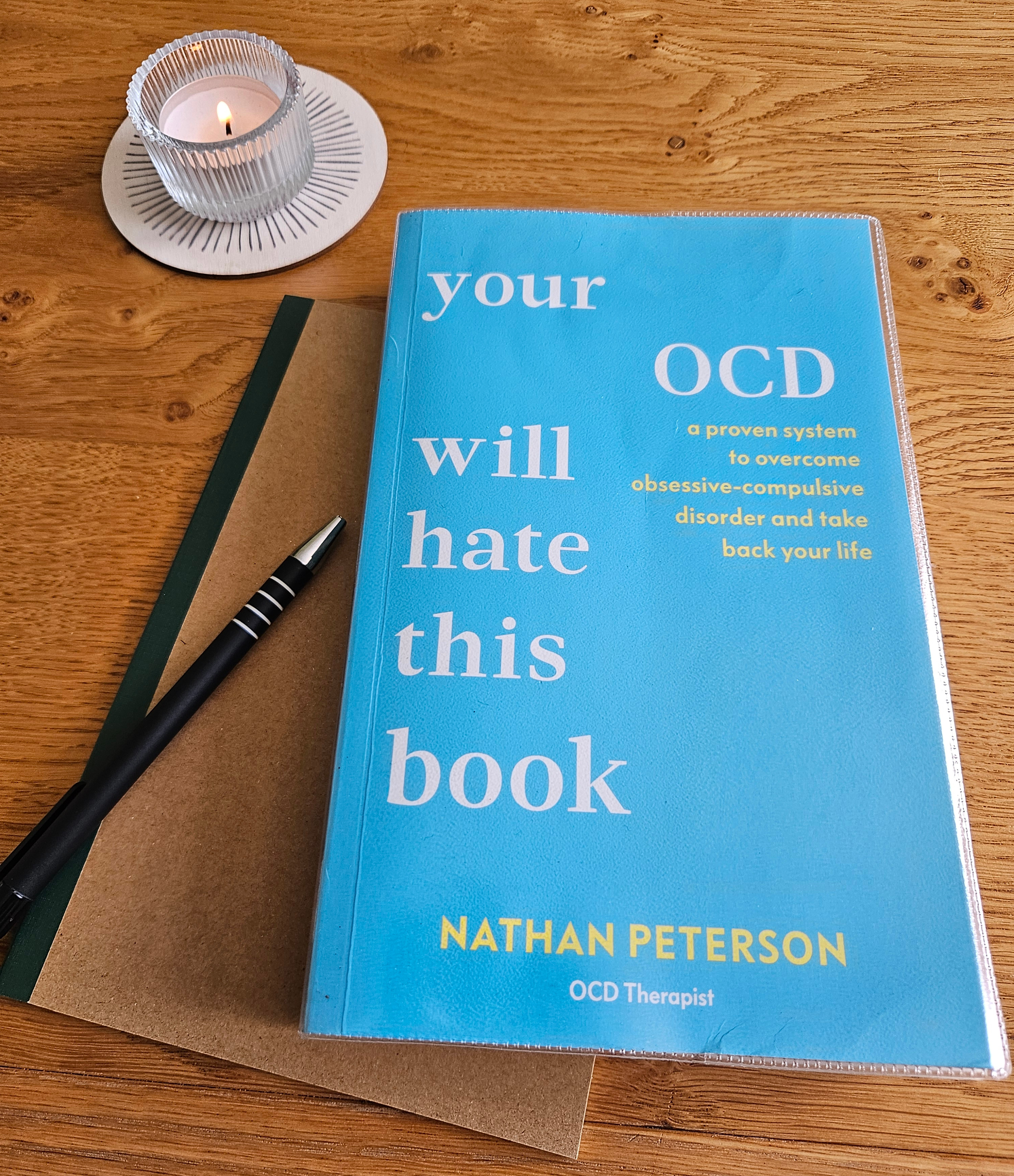
On a recent trip to the library, I spotted this brand-new shiny OCD book, released in July 2026, with a provocative title. As a psychologist offering evidence-based treatment for OCD, and wanting to promote accessible, evidence-based self-help material, I had to read it and let you know what I think.
My takeaways from Your OCD Will Hate This Book
1. It sticks to the core of ERP
One of the things I liked most about this book was that it doesn't shy away from the behavioural part of treatment.
EPR (Exposure and Response prevention) is considered the frontline, gold standard therapy for treatment of OCD. It’s not an easy therapy, but it is effective. It involves gradually exposing ourselves to things (thoughts or situations) we fear and dropping compulsive behaviours that don’t really keep us safe. So that we can learn something new.
It’s the doing something different that creates change. And this book keeps coming back to that key point. It takes time to lay out why, and how and will help break it down into manageable steps, there is even a chapter looking at other approaches that can support (but not replace) ERP and the message is consistent: recovery involves changing the behaviours that keep the OCD cycle going.
2. The worksheets are great
To help you do the work (not just read about it). There are worksheets and exercises throughout, and the book includes QR codes that allow you to access editable PDF versions. I thought this was great because you can use them again. They’re easy to access, you can print or fill them out or just refer to them whenever you need them. They can become something you practice regularly, not just complete once and forget about.
The book provides a clear structure for planning exposures and response prevention, alongside examples across different OCD themes. This makes the process feel much more concrete and offers a starting point for putting the ideas into practice.
3. I loved the metaphors
There are some nice metaphors throughout the book, which are memorable, relatable and motivational.
Living with OCD is compared to not riding a bike unless someone can guarantee that you won't fall off.
As for ERP, it's like an elastic band: exposure is like stretching an elastic band. If you give in to the compulsion, you essentially let the band snap back into its old position. You might get some short-term relief, but you haven't changed the pattern.
If you keep stretching and resist the compulsion, eventually the band breaks.
4. Recovery isn't presented as "once you're better, you're done"
Another thing I appreciated was the realistic description of recovery and maintenance.
There will be times when OCD gets louder again. There may be periods of stress, illness or change when old patterns become more tempting. A lapse doesn't mean that all your progress has disappeared.
The book gives some useful guidance around maintaining progress and getting back on track when OCD starts to creep back in.
One thing I felt was missing
There is a lot to like about this book, but there was one area where I found myself wanting a little more.
I would have liked more space devoted to just how difficult and debilitating OCD can be.
The book doesn't ignore this. It acknowledges the impact OCD can have, and I liked the "finding your why" exercise, which encourages readers to think about what OCD has taken from them and what motivates them to recover.
However, I think there can sometimes be an assumption that once we understand that OCD is essentially a faulty alarm system, identify what matters to us and understand what we need to do differently, we're ready to get started with ERP. In my experience as a clinician, that isn't always the case.
For someone who has lived with severe or longstanding OCD, there can be a lot to work through before feeling ready to step into the behavioural work.
Externalising OCD is a common part of ERP. We often talk about OCD as though it is separate from us, something that has been taking things away from us and that we now need to reclaim our lives from. And I think there is a lot of value in that.
But OCD is also a pattern of beliefs and behaviours that someone may have lived with for years. Often, those patterns developed because the person was trying to protect something that mattered deeply to them.
Untangling ourselves from that relationship with OCD can bring up grief, shame and fear. There can be a real sense of loss involved in recognising how much time and opportunity OCD has taken, that may require more space and compassion that the book facilitates.
I don't see this as a criticism of the book. Rather, I think it reflects who the book is likely to be most useful for. Your OCD Will Hate This Book is a practical guide for people who are ready to engage with ERP, and it does that really well. For people who are earlier in their journey, or who are finding it difficult to imagine themselves doing the work described in the book, there may be a need for more support and space to explore what is getting in the way of that readiness.
A slight disagreement: what about i-CBT?
There was one other part of the book where I found myself wanting to add a little nuance.
In the chapter about other approaches, Inference-based cognitive behavioural therapy (i-CBT) is described it as an approach that claims OCD can be treated by challenging the reasoning behind obsessions rather than doing exposures. The author raises the concern that this can become an attempt to "out-logic" OCD, or potentially provide another way of avoiding the difficult behavioural work.
As an i-CBT provider, I would frame this a little differently.
People with OCD often recognise that the way they reason when they are caught up in an obsession feels different from how they think about other areas of their lives. And most people don’t live their life actively tolerating the uncertainty of many horrible things that could happen, we simply don’t consider them a relevant possibility that requires our attention.
i-CBT focuses on helping people recognise how an obsession has been created, how they have moved from something happening in the here-and-now into an imagined possibility, and how they have become caught up in the reasoning process that makes the obsession feel real and urgent.
The aim of i-cbt is to develop awareness of how we got to the obsessive doubt, in that moment. That awareness can make it easier to step back from the obsession rather than getting pulled further into it, and from there, to make a different choice about compulsive behaviours. It’s still hard work, but in different ways.
In my experience, I find it can be a compassionate approach for people who have tried ERP and struggled with it.
Would I recommend the book?
Yes.
I would recommend Your OCD Will Hate This Book to someone with OCD who hasn't tried ERP before. It is clearly written, easy to read, and practical.
The worksheets and structured exercises make it particularly useful for someone who wants to understand ERP and start putting it into practice.
I would also recommend it to someone who has previously benefited from ERP but is experiencing a lapse and wants to reconnect with the approach.
For people experiencing severe or longstanding OCD. A self-help book can be an incredibly useful resource, but sometimes you need someone alongside you to help you work out where to start, what is keeping you stuck and how to approach the work.
The book itself acknowledges that it can be used alongside therapy, and I think it could be very effectively used in this way.
Final thoughts
Overall, I enjoyed this book.
I liked the conversational style and the sense that there was a real person behind the writing. There is some humour, which was welcome when you're talking about something as serious and exhausting as OCD.
More importantly, the book doesn't dance around the central message and practice of ERP. I think Your OCD Will Hate This Book does a good job of making that process feel understandable and achievable without pretending that it is easy.
If you're looking for a practical introduction to ERP, or a reminder of what you already know but perhaps haven't been practising lately, I think this is a book worth picking up.
If you're interested in using this book alongside therapy; are looking for some ad-hoc support around a self-help approach; or are thinking about ERP or i-cbt for OCD, please feel welcome to reach out by email or book a compatibility call.
